When undertaking a basement construction project, the selection and configuration of concrete mixer pumps directly affect the efficiency, quality, and safety of the entire project. As a project manager or procurement personnel, you need to work closely with concrete pumps suppliers to ensure that the concrete mixer pumps for sale meet the specific needs of basement construction—this process requires systematic communication, parameter verification, and practical verification, rather than a simple purchase transaction. Below is a detailed guide to help you accurately confirm the configuration of concrete mixer pumps with suppliers, avoiding mismatches that may lead to construction delays or cost overruns.
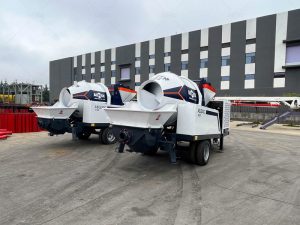
Step 1: Clarify Basement Construction Requirements and Convey Them to Concrete Pumps Suppliers
Before contacting concrete pumps suppliers to discuss concrete mixer pumps for sale, you must first sort out the detailed requirements of your basement project, as this is the foundation for confirming the pump configuration. Basement construction has unique characteristics: for example, the construction space is often narrow (especially for deep basements), the concrete pouring height varies (some require vertical conveying from the ground to the basement floor), and the pouring speed needs to match the formwork solidification time to prevent cracks. You need to sort out key data such as the basement’s floor area, pouring thickness per layer, required daily concrete output, maximum vertical conveying height (e.g., if the basement is 3 floors deep, the vertical height may reach 10-15 meters), and the minimum turning radius of the pump in the construction site.
When communicating with concrete pumps suppliers, do not just mention “needing a concrete mixer pump”—instead, present these specific data clearly. For example, you can say: “Our basement project has a total construction area of 5,000 square meters, with 2 underground floors; each layer requires pouring 80 cubic meters of C30 concrete, and the maximum vertical conveying height from the ground to the bottom of the basement is 12 meters. The construction site’s passage between the material yard and the basement entrance is only 3 meters wide, so the pump needs a small turning radius.” This detailed information allows suppliers to initially screen suitable concrete mixer pumps for sale from their product range, avoiding them recommending models that are too large (unable to enter the site) or too small (insufficient output). At the same time, you should also ask suppliers to provide a “configuration plan based on project needs” in writing, which should include the model number of the recommended pump, key parameters matching the project, and a explanation of why this model is selected—this document can be used as a reference for subsequent parameter verification.
Step 2: Verify Core Configuration Parameters of Concrete Mixer Pumps for Sale with Suppliers
After the supplier provides the initial configuration plan, you need to conduct a in-depth verification of the core parameters of the concrete mixer pump—these parameters directly determine whether the pump can meet the actual construction needs. The first parameter to focus on is the concrete output (also known as the delivery capacity). The supplier may recommend a pump with a theoretical output of 50 cubic meters per hour, but you need to ask for the “actual output under basement construction conditions”—because in narrow spaces, the speed of feeding materials to the pump may be reduced, and the actual output may be 80-90% of the theoretical value. For example, if your project requires 80 cubic meters of concrete per day and the construction time is 8 hours, the actual output of the pump needs to be at least 10 cubic meters per hour; if the supplier’s recommended pump has an actual output of only 8 cubic meters per hour, it will take 10 hours to complete the daily task, which may delay the construction schedule.
The second key parameter is the conveying height and distance. For basement construction, vertical conveying height is more critical than horizontal distance. You need to confirm with the supplier the “maximum vertical conveying height” of the recommended concrete mixer pump for sale, and require them to provide test data (e.g., “this model has passed a vertical conveying test of 20 meters, and the concrete segregation rate is less than 3%”). At the same time, you should also ask about the pump tube configuration—for example, whether the pump is equipped with a wear-resistant alloy tube (suitable for long-term use in basement projects with frequent conveying) and whether the length and bending degree of the tube match the basement’s conveying path. Some suppliers may cut corners by using ordinary steel tubes, which are prone to wear and tear after 1-2 months of use, leading to frequent replacements and increased costs—so you need to clearly specify the material and thickness of the pump tube in the configuration agreement.
The third parameter is the mixing system configuration. A concrete mixer pump integrates mixing and conveying functions, so the performance of the mixing system directly affects the quality of concrete. You need to ask the supplier about the type of mixer (e.g., twin-shaft forced mixer or single-shaft mixer—twin-shaft mixers are more suitable for basement projects because they mix concrete more evenly and have higher efficiency), the mixing drum capacity (whether it can match the pump’s output to avoid the mixer being unable to supply materials in time), and the power of the mixing motor (to ensure that it can mix concrete with different slump values, as basement concrete may need to adjust slump according to the pouring part, such as 120±20mm for beam-column pouring and 180±20mm for floor pouring). In addition, you should also confirm whether the mixing system is equipped with a overload protection device—this is very important for basement construction, as if the mixer is overloaded due to excessive aggregate, it may cause motor burnout, and the narrow basement space will make maintenance more difficult.
Step 3: Confirm After-Sales Support and Configuration Adjustment Clauses with Suppliers
Basement construction is often a long-term project (usually taking 3-6 months), and the concrete mixer pump will be in continuous operation for a long time—so the supplier’s after-sales support and the flexibility of configuration adjustment are also important parts of confirming the configuration. First, you need to confirm the after-sales service scope with the supplier: for example, whether they provide on-site installation and debugging (critical for basement sites where equipment installation space is limited), how long the warranty period is (the core components such as the pump motor and mixer should have a warranty period of at least 1 year), and how quickly they can respond to maintenance requests (in basement construction, if the pump breaks down, it may cause the concrete in the pipeline to solidify, leading to huge losses—so the supplier should promise to send maintenance personnel within 24 hours).
Second, you need to negotiate configuration adjustment clauses in the contract. During the actual construction of the basement, you may encounter unexpected situations: for example, the design is changed, and the vertical conveying height needs to be increased by 5 meters; or the concrete slump required for the basement wall is higher than expected, and the mixer’s mixing speed needs to be adjusted. At this time, if the original configuration cannot meet the new needs, you need the supplier to provide configuration adjustments (such as replacing a longer pump tube or upgrading the mixer motor). You should clearly write in the contract: “If the project needs to adjust the pump configuration due to design changes or construction conditions, the supplier shall provide adjustment solutions within 3 working days, and the cost of adjustment shall be calculated according to the actual changes (excluding costs caused by the buyer’s own mistakes).” This clause can avoid disputes when configuration adjustments are needed later.
In addition, you can also ask the supplier to provide on-site training for the project’s operating personnel. The operation of concrete mixer pumps requires professional skills, and the special environment of the basement (such as poor lighting and narrow space) increases the difficulty of operation. If the operator is not familiar with the pump’s operation procedures, it may cause misoperation (such as incorrect adjustment of the conveying speed), leading to equipment failure or concrete quality problems. The supplier’s training should include not only basic operation methods but also emergency handling (e.g., what to do if the concrete pipeline is blocked, how to shut down the equipment safely in case of power failure in the basement). You can require the supplier to issue a training certificate to the operators after the training, ensuring that the operators have the ability to use the pump correctly.
Step 4: Conduct On-Site Inspection or Test Operation to Finalize the Configuration
Before signing the purchase contract, it is best to conduct an on-site inspection of the concrete mixer pumps for sale recommended by the supplier or request a test operation—this is the most direct way to confirm whether the configuration meets the needs. If the supplier has a showroom or a nearby project using the same model, you can visit the site to check the pump’s appearance (whether the structure is compact, suitable for basement space), the quality of key components (such as the brand of the pump motor—well-known brands like Cummins have higher reliability), and the operation status (whether the mixer runs smoothly, whether the concrete conveying is stable). During the inspection, you can bring the project’s technical personnel together—they can put forward more professional questions (such as the service life of the pump’s wearing parts, the difficulty of replacing the pipeline) to the supplier’s technical staff.
If the supplier’s conditions allow, you can also request a test operation in the actual basement construction site (or a simulated site similar to the project’s conditions). For example, you can ask the supplier to transport the concrete mixer pump to your project site, and conduct a small-scale concrete pouring test: use the pump to convey concrete to the basement’s designated pouring area, measure the actual output (calculate the amount of concrete poured in 1 hour), check the concrete’s uniformity after conveying (whether there is segregation), and test the pump’s mobility (whether it can turn smoothly in the site’s narrow passage). During the test operation, you should record all data in detail—if the actual output, conveying height, and operation flexibility all meet the project’s requirements, you can confirm the configuration; if there are problems (such as the pump’s turning radius being too large to enter the basement entrance), you can ask the supplier to adjust the configuration (such as replacing a pump with a shorter body) or recommend other models.
Finally, after confirming all configuration details (including parameters, after-sales support, and training), you need to write all the agreed contents into the purchase contract—do not rely on oral commitments. The contract should clearly state the model number of the concrete mixer pump, all core configuration parameters (with allowable error ranges), the scope and duration of after-sales service, the responsibility for configuration adjustment, and the penalty clauses for non-compliance (e.g., if the supplier’s actual pump parameters do not match the agreed ones, they shall compensate for the project’s losses caused by the delay). This contract will be the most important guarantee for your basement project to use the correct concrete mixer pump configuration.
Leave a Reply