The small concrete boom pump is a core piece of concrete pump equipment widely used in urban renovation, residential construction, and small-scale infrastructure projects, with its flexibility and efficiency making it indispensable for narrow construction sites. Ensuring the quality of a small concrete boom pump is directly related to operational safety, construction efficiency, and project progress—poor-quality equipment may lead to boom collapse, concrete leakage, or mechanical failures, resulting in safety accidents and economic losses. Evaluating the quality of a small concrete boom pump requires a comprehensive assessment of its structural design, core components, safety systems, and performance stability, with a focus on safety-oriented indicators to lay a solid foundation for secure operation.
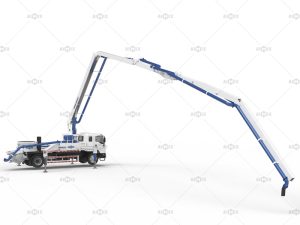
Assess Structural Design and Material Quality of the Small Concrete Boom Pump
The structural design and material quality are the fundamental guarantees for the safe operation of a small concrete boom pump, as they determine the equipment’s load-bearing capacity, stability, and durability. First, focus on the boom structure—the core component of the small concrete boom pump— which is responsible for conveying concrete to the target position. Evaluate whether the boom adopts a reasonable section design, such as a box-type or truss structure, to ensure uniform force distribution and strong load-bearing capacity. High-quality small concrete boom pumps typically use high-strength alloy steel for the boom, which balances light weight and rigidity, reducing the burden on the chassis while resisting deformation during operation. Check the welding quality of the boom joints and connections, as defective welding may cause cracks or even breakage under repeated load pressure. Observe whether the welds are smooth, free of pores, and fully fused, and request the manufacturer to provide welding inspection reports to verify compliance with industry standards. Additionally, assess the overall structural layout of the small concrete boom pump, including the connection between the boom and the chassis, the placement of hydraulic cylinders, and the arrangement of pipelines. A scientific layout can improve operational stability, avoid mutual interference between components, and reduce the risk of failures caused by structural stress concentration. As a key concrete pump equipment, the small concrete boom pump’s structural quality must meet strict safety specifications to withstand long-term high-frequency operation.
Inspect Core Components of Concrete Pump Equipment for Reliability
The reliability of core components directly affects the safe operation and service life of the small concrete boom pump, as these components are the “heart” and “nerve” of the concrete pump equipment. First, evaluate the hydraulic system, which drives the boom’s lifting, luffing, and concrete pumping. High-quality small concrete boom pumps are equipped with hydraulic pumps, motors, and cylinders from well-known brands, ensuring stable pressure output and smooth operation. Check whether the hydraulic system has a reasonable pressure relief device and overflow valve to prevent overpressure from damaging components or causing boom jitter. Inspect the hydraulic pipelines and seals for quality—high-pressure resistant hoses with wear-resistant and corrosion-resistant properties should be used, and the seals should fit tightly to avoid hydraulic oil leakage, which may lead to sudden boom failure. Second, assess the pumping system, including the concrete cylinder, piston, and S-valve. The concrete cylinder and piston should be made of wear-resistant materials to withstand the friction of concrete, and the S-valve should have flexible switching performance to ensure continuous and stable concrete conveyance. Evaluate the lubrication system of the small concrete boom pump, as effective lubrication can reduce wear between moving components and prevent overheating. Check whether the lubrication system can automatically supply oil to key parts such as the boom hinges and pumping mechanism, and verify the quality of the lubricating oil used to ensure it meets the equipment’s operating requirements. Finally, inspect the chassis and walking system—for mobile small concrete boom pumps, the chassis should have reliable braking performance and stability, enabling safe movement and positioning on uneven construction sites.
Evaluate Safety Protection Systems and Control Accuracy
Safety protection systems and control accuracy are crucial for preventing accidents during the operation of a small concrete boom pump, as they can effectively avoid human error and mechanical failures. First, check the safety protection devices configured on the small concrete boom pump, including overload protection, boom anti-collision, emergency stop, and stability support systems. The overload protection system should automatically cut off the power or issue an alarm when the boom exceeds the rated load, preventing structural damage. The boom anti-collision system uses sensors to detect obstacles around the boom, reminding the operator to adjust the operation range and avoiding collisions. The emergency stop button should be installed in an easily accessible position, allowing the operator to shut down the equipment immediately in case of an emergency. The stability support system—including outriggers and support pads—must have sufficient load-bearing capacity to ensure the small concrete boom pump remains stable during boom operation, avoiding tipping due to uneven force. Second, evaluate the control system’s accuracy and responsiveness, which directly affects operational safety and construction quality. The control system of a high-quality small concrete boom pump should have both manual and automatic control modes, with precise control over boom lifting, luffing, and concrete flow rate. Test the responsiveness of the control lever or touch screen—operations should be smooth and free of delay, and the boom should move stably without jitter. Check whether the control system is equipped with a fault diagnosis function, which can quickly identify and display faults such as hydraulic system abnormalities or electrical failures, helping operators and maintenance personnel resolve issues in a timely manner. As a precision concrete pump equipment, the small concrete boom pump’s control system must be reliable and accurate to ensure safe and efficient operation.
Test Performance Stability and Operational Adaptability
Performance stability and operational adaptability are important indicators to evaluate the quality of a small concrete boom pump, as they reflect the equipment’s ability to maintain safe operation under different working conditions. Conduct on-site trial operation to test the small concrete boom pump’s performance under rated load—observe the boom’s lifting and luffing speed, ensuring it remains stable without abnormal vibration or noise. Evaluate the pumping performance by conveying concrete of different consistencies, checking whether the flow rate is stable, and whether there is leakage at the pipeline connections or boom outlets. Test the equipment’s operation under extreme conditions, such as high or low temperatures, to verify its adaptability—high-quality small concrete boom pumps can maintain stable performance within a certain temperature range, without component failures caused by environmental factors. Additionally, assess the equipment’s noise level during operation, as excessive noise may indicate poor component quality or improper assembly, which may affect long-term safe operation. For small concrete boom pumps used in urban areas, low noise is also an important indicator to avoid disturbing the surrounding environment. During the trial operation, record key data such as fuel consumption, hydraulic system temperature, and boom operation accuracy, comparing them with the manufacturer’s technical parameters to verify whether the equipment meets the quality standards. As a practical concrete pump equipment, the small concrete boom pump must have excellent performance stability and adaptability to cope with complex construction site conditions.
Verify Manufacturer’s Quality Control and After-Sales Support
The manufacturer’s quality control system and after-sales support are indirect but important factors in evaluating the quality of a small concrete boom pump, as they reflect the manufacturer’s responsibility and ability to ensure product safety. First, inquire about the manufacturer’s quality control process, including incoming inspection of raw materials and components, in-process quality inspection, and final product testing. A reliable manufacturer will establish a strict quality control system, conducting multiple inspections throughout the production process to eliminate defective products. Request the manufacturer to provide product certification, such as ISO quality management system certification and national industrial product production license, to confirm that the small concrete boom pump meets national and international safety and quality standards. Second, evaluate the manufacturer’s after-sales support capabilities, which are crucial for resolving quality issues and ensuring safe operation during the equipment’s service life. Inquire about the warranty period for the small concrete boom pump and core components, as well as the after-sales service network and response time. A professional manufacturer should have a sound after-sales service team, capable of providing on-site maintenance, component replacement, and technical guidance in a timely manner. Ask whether the manufacturer offers training services for operators and maintenance personnel, helping them master the correct operation methods and daily maintenance skills to avoid safety accidents caused by improper operation. Additionally, understand the supply cycle of spare parts, ensuring that genuine spare parts can be obtained quickly when needed to minimize downtime and ensure continuous safe operation of the concrete pump equipment.
In summary, evaluating the quality of a small concrete boom pump for safe operation requires a comprehensive approach covering structural design, core components, safety systems, performance stability, and manufacturer support. By focusing on these key aspects, users can select high-quality concrete pump equipment, effectively reduce safety risks, and ensure the smooth progress of construction projects.
Leave a Reply