In the construction machinery industry, the cost of concrete pump operation is a core concern for construction enterprises and equipment lessors, among which diesel cost, as a major variable expenditure, directly affects the overall operational efficiency and profitability. Mini concrete pumps, designed for small-scale projects such as rural house construction, township road maintenance, and small municipal engineering, are widely recognized for their flexibility and compact structure. Compared with larger concrete pumps (such as truck-mounted concrete pumps with long booms), there is a common perception that mini concrete pumps have lower daily diesel consumption. However, this perception needs to be verified through in-depth analysis of equipment performance, operating conditions, and actual consumption data. This article explores whether mini concrete pumps indeed have lower daily diesel costs than bigger ones, focusing on core influencing factors and practical application scenarios.
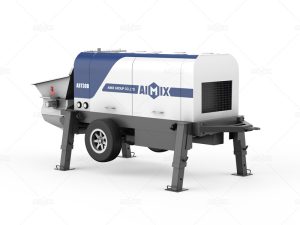
Core Differences in Equipment Design: The Foundation of Diesel Consumption Gap
The difference in daily diesel consumption between mini concrete pumps and bigger ones originates from their inherent design differences, especially in power configuration, structural weight, and functional positioning. These design characteristics directly determine the energy demand of the equipment during operation, thereby affecting the daily diesel cost of concrete pump operation.
1. Power System Configuration: Smaller Power, Lower Basic Consumption
Mini concrete pumps are mainly developed for small-scale construction scenarios, and their power systems are designed to be more compact and energy-efficient. Taking diesel-powered mini concrete pumps as an example, the mainstream power range in the market is 53KW to 83KW, such as the 83KW Weifang diesel engine model, which can meet the pumping demand of 40 cubic meters per hour while maintaining relatively low fuel consumption. In contrast, bigger concrete pumps, such as 47-56 meter truck-mounted concrete pumps used for high-rise buildings and large-scale infrastructure projects, are equipped with high-power diesel engines ranging from 200KW to 350KW to drive the large-diameter pumping system, long boom lifting mechanism, and heavy chassis. The higher power output means that even in the idle state, bigger concrete pumps consume more diesel than mini concrete pumps in working state. This basic power gap determines that mini concrete pumps have an inherent advantage in reducing daily diesel consumption, which directly translates into a lower daily diesel cost compared with bigger ones.
It is worth noting that the power matching of mini concrete pumps is more precise. Manufacturers will optimize the power output according to the actual pumping pressure and speed requirements, avoiding the “big horse pulling a small cart” phenomenon common in bigger concrete pumps when they are used for small projects. For example, when a 56-meter concrete pump (with a power of 300KW) is used for rural house construction with a daily pumping volume of only 50 cubic meters, its power utilization rate is extremely low, and most of the diesel is consumed in idle operation, resulting in a significant increase in unit diesel consumption. In contrast, mini concrete pumps can achieve high power utilization rate in their targeted scenarios, further reducing unnecessary diesel waste and lowering the daily diesel cost of concrete pump operation.
2. Structural Weight and Mobility: Less Energy Consumption for Operation
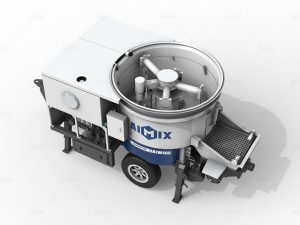
The structural weight of the equipment is another key factor affecting diesel consumption. Mini concrete pumps adopt a lightweight design, with an overall weight usually between 3 tons and 8 tons, and some integrated mini mixing and pumping machines even have a more compact structure, which can adapt to narrow construction sites and limited road conditions. The lighter weight means that less diesel is consumed when the equipment is moving and adjusting its position on the construction site. For example, when transferring the operation position within the construction site, a mini concrete pump only needs to consume a small amount of diesel to drive the crawler or wheeled chassis, while a bigger concrete pump (with an overall weight of 20-40 tons) requires more diesel to overcome the resistance of its own weight, increasing the daily diesel consumption.
In addition, the mobility design of mini concrete pumps is more conducive to reducing diesel consumption. Most mini concrete pumps can be quickly transferred between nearby construction sites without relying on large transport vehicles, which not only saves transportation costs but also avoids the additional diesel consumption caused by the long-distance transportation of bigger concrete pumps. For construction teams that need to operate multiple small projects in the same area, the low mobility energy consumption of mini concrete pumps can significantly reduce the total daily diesel cost, which is an advantage that bigger concrete pumps cannot match.
Operating Condition Factors: The Key to Determining Actual Diesel Cost Differences
Although mini concrete pumps have inherent advantages in design, the actual daily diesel cost is also affected by operating conditions, including pumping volume, construction environment, and operation proficiency. In different operating scenarios, the gap in diesel consumption between mini concrete pumps and bigger ones may change, but overall, mini concrete pumps still maintain a lower daily diesel cost advantage.
1. Pumping Volume Matching: Mini Pumps Have Lower Unit Consumption in Small-Scale Scenarios
The daily pumping volume is the most direct factor affecting the diesel consumption of concrete pumps. For small-scale projects with a daily pumping volume of 30-80 cubic meters (such as rural three-story houses, township road repairs), mini concrete pumps can operate at their optimal efficiency interval, with a unit diesel consumption of about 0.3-0.5 liters per cubic meter. According to this calculation, the daily diesel consumption is only 15-40 liters, and the daily diesel cost is about 100-270 yuan (based on 6.82 yuan per liter of diesel). In contrast, if bigger concrete pumps are used for the same projects, their unit diesel consumption will rise to 0.8-1.2 liters per cubic meter due to low power utilization rate, and the daily diesel consumption will reach 40-96 liters, with a daily diesel cost of 270-655 yuan. This shows that in small-scale pumping scenarios, the daily diesel cost of mini concrete pumps is significantly lower than that of bigger ones.
Even in the case of large daily pumping volume (such as 100-150 cubic meters), mini concrete pumps still have certain cost advantages when used in combination. For example, two mini concrete pumps (each with a daily pumping volume of 75 cubic meters) can complete the work, with a total daily diesel consumption of 75-150 liters and a total diesel cost of 510-1020 yuan. A single bigger concrete pump with the same pumping capacity (150 cubic meters per day) has a daily diesel consumption of 120-180 liters and a diesel cost of 820-1230 yuan. Although the initial investment of using two mini concrete pumps is higher, the lower daily diesel cost can save a lot of operating expenses in the long run, which is more in line with the cost control needs of construction enterprises.
2. Construction Environment Adaptability: Reducing Additional Diesel Consumption
The construction environment also has a significant impact on the daily diesel consumption of concrete pumps, and mini concrete pumps have stronger adaptability to complex small-scale construction environments, which can further reduce additional diesel consumption. In rural and remote areas, construction sites are often uneven, with narrow roads and limited turning space. Mini concrete pumps, with their small size and flexible operation, can quickly adjust their position without repeated moving and debugging, thereby reducing diesel consumption caused by frequent start-up and shutdown. In contrast, bigger concrete pumps have high requirements for the flatness and width of the construction site. They often need to adjust the chassis and boom position repeatedly, and even use auxiliary equipment to level the site, which increases unnecessary diesel consumption and raises the daily diesel cost.
In addition, for outdoor construction in high temperature, high altitude and other harsh environments, mini concrete pumps have better heat dissipation and power adaptation performance. Their compact power system is easier to maintain stable operating temperature, avoiding diesel consumption increase caused by overheating of the engine. Bigger concrete pumps, due to their complex power system and large heat generation, need to consume more diesel to drive the cooling system in harsh environments, further widening the gap in daily diesel cost with mini concrete pumps.
3. Operation Proficiency: Optimizing Diesel Consumption Efficiency
The proficiency of operators also affects the daily diesel consumption of concrete pumps, but this factor has a more obvious impact on bigger concrete pumps. Bigger concrete pumps have complex operating systems, involving boom control, pumping pressure adjustment, and chassis movement. Unskilled operators are prone to improper operation such as excessive acceleration, unstable pumping speed, and frequent emergency braking, which will increase diesel consumption by 10%-20%. In contrast, mini concrete pumps have a simpler operating interface and lower technical requirements for operators. After short-term training, operators can master the standard operation methods, ensuring that the equipment operates in the optimal fuel consumption interval. This operational simplicity makes the daily diesel consumption of mini concrete pumps more stable and less likely to be affected by human factors, further ensuring that their daily diesel cost is lower than that of bigger ones.
Comprehensive Cost Comparison: Beyond Diesel Consumption
When evaluating whether the daily operation of mini concrete pumps has less diesel cost than bigger ones, it is necessary to place it in the context of the overall cost of concrete pump operation, because diesel cost is only one part of the total operating cost. However, even considering other cost factors, the advantage of mini concrete pumps in diesel cost still plays a key role in reducing the overall operating cost.
1. Unit Diesel Cost vs. Overall Operating Cost
The daily operating cost of concrete pumps includes diesel cost, maintenance cost, labor cost, and depreciation cost. For mini concrete pumps, the daily diesel cost accounts for about 30%-40% of the total operating cost, while for bigger ones, this proportion is as high as 40%-50% due to higher diesel consumption. Taking a daily pumping volume of 60 cubic meters as an example, the daily diesel cost of a mini concrete pump is about 180 yuan (0.5 liters per cubic meter × 60 cubic meters × 6.82 yuan/liter), and the total daily operating cost is about 450-600 yuan. The daily diesel cost of a bigger concrete pump is about 328 yuan (0.8 liters per cubic meter × 60 cubic meters × 6.82 yuan/liter), and the total daily operating cost is about 820-1090 yuan. It can be seen that the lower diesel cost of mini concrete pumps directly drives down the total daily operating cost, making them more cost-effective in small-scale construction scenarios.
2. Maintenance Cost Synergy: Further Reducing Comprehensive Expenses
The maintenance cost of mini concrete pumps is also lower than that of bigger ones, which to a certain extent synergizes with the diesel cost advantage. Mini concrete pumps have a simple structure and fewer wearing parts, and the daily maintenance only needs to replace lubricating oil and check the sealing components, with a daily maintenance cost of about 50-80 yuan. Bigger concrete pumps have complex systems such as long booms, high-pressure pumping cylinders, and multi-functional control systems, requiring regular replacement of high-cost wearing parts such as pump pipes, pistons, and hydraulic valves, with a daily maintenance cost of 150-200 yuan. The combination of lower diesel cost and maintenance cost makes mini concrete pumps have a more obvious comprehensive cost advantage, which is particularly important for small and medium-sized construction enterprises and individual operators sensitive to the cost of concrete pump operation.
Misunderstandings and Special Cases: Rational View of Diesel Cost Differences
While affirming that mini concrete pumps have lower daily diesel costs than bigger ones in most scenarios, it is also necessary to avoid one-sided understanding and pay attention to some special cases where the cost gap may narrow or even reverse. Only by rationally viewing these situations can we make scientific decisions on equipment selection based on actual project needs.
1. Misunderstanding: Blindly Pursuing Low Diesel Cost and Ignoring Project Adaptability
Some operators mistakenly believe that mini concrete pumps are better in all scenarios because of their lower diesel cost, but in fact, mini concrete pumps have limitations in pumping height and distance. For example, for high-rise building construction with a pumping height of more than 30 meters or long-distance pumping projects with a distance of more than 100 meters, mini concrete pumps cannot meet the construction requirements due to insufficient power and pumping pressure. At this time, bigger concrete pumps must be used, and the higher diesel cost becomes an inevitable expenditure. Therefore, the choice of equipment should first be based on project needs, and diesel cost should be considered as a secondary factor to avoid affecting project progress and quality due to inappropriate equipment selection.
2. Special Case: Large-Scale Continuous Operation Scenarios
In large-scale continuous operation scenarios with a daily pumping volume of more than 200 cubic meters (such as large-scale infrastructure projects like bridges and high-speed railways), bigger concrete pumps may have a lower unit diesel consumption. This is because bigger concrete pumps can maintain high power utilization rate in continuous high-load operation, and their unit diesel consumption can be reduced to 0.6-0.7 liters per cubic meter. In contrast, if multiple mini concrete pumps are used for continuous operation, the total diesel consumption may be higher due to the cumulative effect of individual equipment consumption. However, such scenarios are usually dominated by large construction enterprises, and the cost of concrete pump operation is only a small part of the total project cost. For most small and medium-sized projects, mini concrete pumps still have an irreplaceable diesel cost advantage.
In conclusion, in most construction scenarios, the daily operation of mini concrete pumps indeed has less diesel cost than bigger ones. This advantage originates from the reasonable power configuration, lightweight structural design, and high adaptability to small-scale projects of mini concrete pumps, which can effectively reduce unnecessary diesel consumption and lower the daily diesel cost of concrete pump operation. Although there are special cases where the cost gap narrows, for the vast majority of rural construction, township engineering, and small municipal projects, mini concrete pumps are more cost-effective in terms of daily diesel consumption and comprehensive operating costs. By choosing equipment according to project characteristics and standardizing operation to optimize diesel consumption, construction enterprises and operators can further reduce the cost of concrete pump operation and improve project profitability.
Leave a Reply